Weather Permitting: The Umbrella Worth Choosing Properly
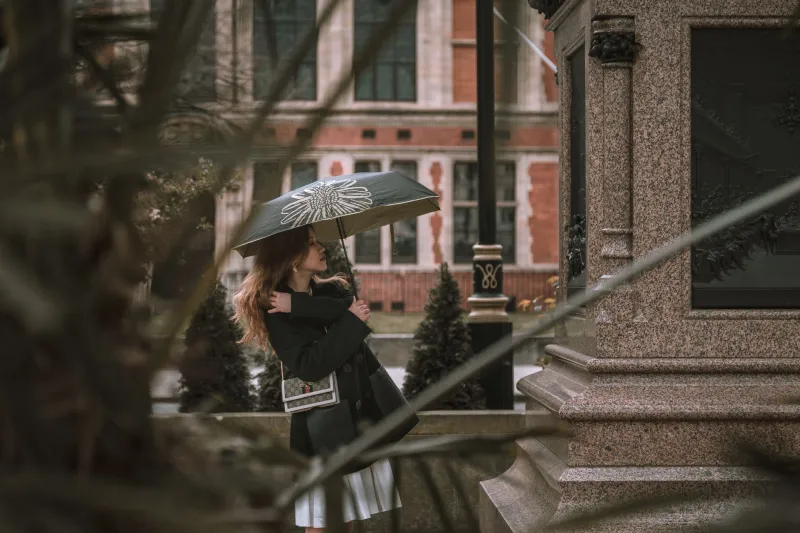
There is a particular kind of November morning in this country that begins with promise and ends at the bus stop with wet shoulders. You left the house in the coat you love, the boots you spent a fortnight deciding on, the bag that holds everything. And then the sky opens, and the only piece of the outfit you did not think about becomes the one everyone can see.
For years, my umbrella was an afterthought: a freebie from a festival, a folding thing that lived in the bottom of a tote and turned inside out at the first gust on the Northern line. Then one wet Tuesday I borrowed a proper one from my mum and understood. It was not a status object. It was simply the difference between arriving as a person and arriving as a weather report.
The fifth piece
We talk about coats, bags and shoes as the finishing notes of an outfit, and rightly so. But in a wet climate, the umbrella sits in that same small circle. It changes your silhouette when it is up, and it changes your posture when it is down. A neat, full-size umbrella held low reads as intent. A damp, crumpled compact jammed under an armpit reads as surrender.
The point is not that you must spend a fortune. It is that nothing about the way you leave the house should feel accidental if you can help it. A finished outfit is not necessarily an expensive one. It is one where the weather has been considered, not just endured.
Compact or full-size: an honest trade-off
There are essentially two shapes worth owning, and they do different jobs.
The compact folding umbrella is the city one. It lives in your bag, it comes out for the ten-minute walk from the Tube, and it does not need a stand by the door. The catch is that many of the smallest ones barely cover your shoulders, and the cheapest have ribs that give up in the first proper wind. If you go compact, go slightly longer and slightly heavier than feels necessary. A folding umbrella with a proper frame and a wooden or leather handle, in the forty to seventy pound range, will outlast four cheap ones.
A full-size stick umbrella is for anyone who walks more than ten minutes, waits at a school gate, or lives somewhere the rain arrives sideways. It covers you properly, it does not invert at the first gust, and it looks like you meant it. The catch is logistics: you need a hand for it, somewhere to hang it at the office, and a hook by the door at home. I keep one in the hall and one at my desk. It is not vanity. It is a small piece of infrastructure.
Whichever you choose, look at the ribs. Fibreglass flexes better than steel in wind, and a vented canopy lets the gust pass through instead of turning your umbrella into a tulip. It is the least glamorous advice in this piece and the most useful.
Handle, colour, cloth
Black is the default, and there is nothing wrong with it. But a navy, an oxblood or a dark olive umbrella reads as something you chose rather than something you grabbed. It sits more easily beside a camel coat or a charcoal one, and it gives a plain outfit a small point of interest without shouting.
The handle matters more than it should. A hook in wood or leather means you can hang it on the back of a chair, over your forearm while you pay for a coffee, or on the rail of a train without it sliding to the floor. Plastic handles are fine until they are not. If you wear rings, a smooth wooden hook is kinder to your hands in the cold.
As for the canopy, a quiet check lining is a nice private pleasure. A slogan is not. If your coat is patterned, keep the umbrella solid and let the two agree. If your coat is plain, a lining with a little colour is the flash of personality you get to enjoy every time you press the button.
Carrying it without looking weighed down
How you hold an umbrella says as much as the umbrella itself. Carry it at your side, tip down, hand relaxed. Do not clamp it under your arm like a rolled newspaper, and do not let it swing out into the pavement.
When it is closed and wet, keep it slightly away from your coat rather than pressed against it. The wrist strap is for windy days, looped over your wrist, not left dangling to catch on a gate. On a crowded train, hold it vertically between your knees, tip on the floor, or hang it from the hook if there is one. In a shop queue, hook it over your forearm and let your hand be free.
If you walk with it up, hold it close to your head rather than at arm's length. You will see more, and you will stop doing that apologetic sideways dance around other people's shoulders.
The small wet-weather kit
This is the part that keeps the rest of the outfit intact, and it takes about ninety seconds to assemble.
In a small pouch in your bag: a microfibre cloth for glasses and a phone screen, a folded plastic sleeve or a sealable bag for the wet canopy, a spare hairband, and a shoe wipe. In the hall at home: a towel by the door, a hook for the umbrella, and a habit of opening it fully to dry overnight, away from a direct radiator. A wet umbrella left furled in a corner grows a smell you cannot un-smell.
If your gloves get soaked, a spare pair in the bag is a small luxury you will thank yourself for. If your coat has a storm flap and a decent hood, use them. The umbrella is not there to replace a good coat. It is there to finish the job.
Repair, not replace
A good umbrella can be re-ribbed. The frame can be restrung, the canopy patched, the handle re-set. There are repairers who will do it for less than you think, and there is a particular satisfaction in a thing that has been mended rather than replaced. A sixty-pound umbrella repaired twice is still cheaper, and far better looking, than a drawer full of twelve-pound ones that all failed in the same wind.
The rain is not a personal failure. It is a Tuesday. Dressing for it, properly and with a little thought, is a small civil act of optimism. And it does not take much: one good umbrella, one hook by the door, one cloth in your bag. The rest of the outfit will do the rest.