Colour That Can Stay for Pudding: A Party Lip for Real Evenings
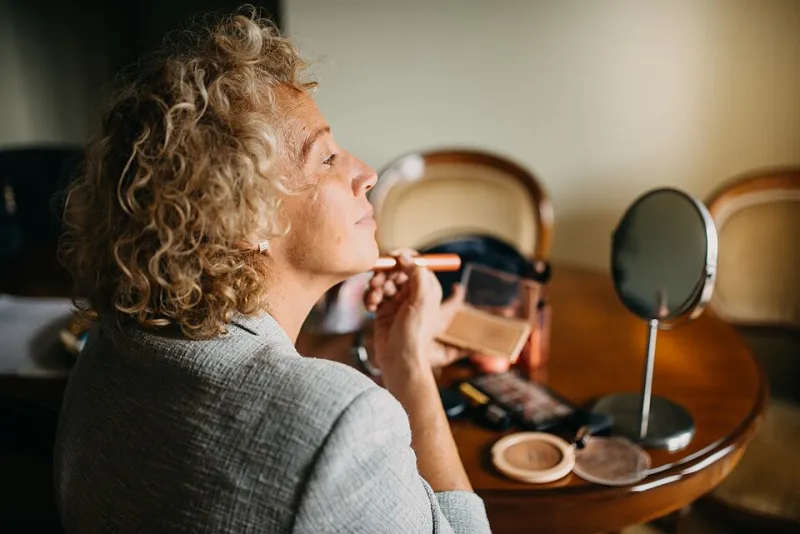
Photo: Shixart1985, CC BY 2.0, via Wikimedia Commons
Most party lipstick advice is written for a woman holding a glass and not much else. The reality of a December night out in the UK is less curated. You arrive flushed from the train, stand too close to a radiator, order something fizzy, eat a mince pie because someone brought them and then catch sight of yourself in the loos at 10:40pm. That is the moment a lip colour either looks like a decision or like it has given up.
I am not interested in a lip that survives a nuclear blast. I am interested in one that fades evenly, keeps its shape and does not make me look like I have been eating jam directly from the jar. The buffet is part of the evening. The lip should be able to cope.
Start with the mouth you actually have
A lot of party makeup starts with the idea that you need a blank, smooth canvas. You do not. You need a mouth that is not actively peeling. The morning of an event, I use a soft toothbrush and a thin layer of balm, then leave it alone. I do not scrub my lips ten minutes before leaving the house. That is how you get tiny cracks that no long-wear formula can disguise.
If your lips are dry, balm goes on early, not under a matte lipstick at the last minute. Give it twenty minutes, blot the excess, then begin. This one small shift stops most of the flaking that people blame on the lipstick itself.
Choose the colour for the room, not the bathroom mirror
Pub lighting is warm, dim and slightly unforgiving in a way that bathroom lighting is not. A cool-toned pink that looks fresh at home can turn chalky by the bar. A deep berry can read almost black in a corner. A bright red can look wonderful, but only if you have chosen one that suits the undertone of your skin rather than the idea of red you saw online.
My rule is to test a shade in two places: near a window in daylight and under a warm bulb. Boots and Superdrug are useful for this because you can swatch on the back of your hand, then hold it near your face. If it makes your skin look grey, put it down. If it makes your teeth look yellow, put it down. If it makes you look slightly more awake, that is the one.
For a party, I would rather choose a colour one notch brighter than my everyday neutral than a dramatic shade I spend the whole night worrying about. A warm rose, a soft brick or a sheer berry is often more flattering under pub lighting than a very cool fuchsia. High-street formulas have become genuinely good at this: Rimmel Lasting Finish, L'Oréal Paris Infallible and Maybelline Super Stay are all easy to find, and none of them require a second mortgage. The point is not the brand. The point is the finish and the colour in the room where you will actually be standing.
The prep that stops the flake
Long-wear lipstick is not paint. It needs a decent surface. After balm and blotting, I line the entire lip lightly with a liner close to my natural colour. This does two things: it gives the colour something to hold on to and it means that when the middle fades after dinner, the edge is still there.
Then I apply the colour in thin layers, blotting between them with a tissue. One thick layer is what cracks. Two thin ones stay flexible. If I am using a matte liquid lipstick, I keep it away from the very centre of my lower lip at first, because that is where pastry, prosecco and conversation do the most damage. I can always add more later.
A formula that can handle a pastry
There is a difference between a lipstick that transfers a little and one that disappears in patches. For a buffet situation, I reach for a flexible matte, a satin or a transfer-resistant liquid rather than a traditional creamy bullet. Creamy formulas are lovely, but they are not built for a mince pie.
Maybelline Super Stay Vinyl Ink is a good example of the sort of thing I mean: it has shine, but it sets and does not slide straight off. Rimmel's long-wear options are reliable and easy to reapply. If you prefer a traditional bullet, choose a satin rather than a high-shine finish, and take it with you. There is no shame in a touch-up. The shame is in pretending you will not need one.
The tiny kit that actually goes out
I do not carry a full lip wardrobe. A small pouch is enough: the lipstick itself, a liner that matches, a blotting paper or two and a tiny balm. If I am wearing a very dark shade, I add a cotton bud. That is it.
The liner is the most useful item because it rebuilds the edge without making the whole mouth look freshly painted. The balm is not for slathering over the top; it is for the tiniest dab in the centre if my lips start to feel tight. Blotting paper is for the prosecco shine and the central heating sheen that makes colour look as if it is melting.
Touch up without starting over
When the colour starts to go, do not just add another layer on top. Blot first. If the lip is patchy, take a tissue with a little balm on it and gently wipe the centre, then reapply a thin layer. If the edge has blurred, use the liner to redraw it before adding colour. If you are in a pub loo with terrible lighting, do the minimum and trust that nobody is inspecting you as closely as you are.
The goal is not a freshly applied lip at 11pm. The goal is a lip that still looks like it belongs to your face.
The mince pie test
At the end of the night, after the pastry and the fizz and the heating, look at your mouth properly. Did the colour fade evenly? Did it leave a ring? Did it feather? That tells you more about the formula and your prep than any mirror selfie ever will.
A good party lip is not the one that survives untouched. It is the one that fails gracefully. If it has faded to a stain that still suits you, that is a success. If it has cracked into a map of tiny lines, make a note and choose differently next time. The mince pie is not the enemy. It is simply the most honest makeup test of the season.